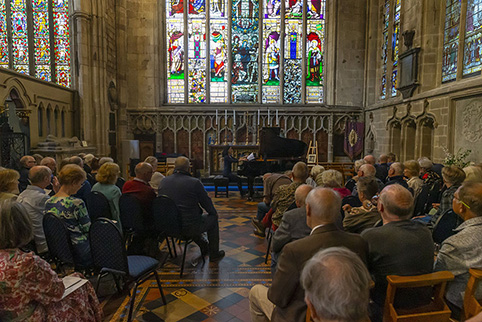
Mariam Batsashvili returned to Shrewsbury for a fraction of her normal fee to christen the new Kawai GX5 grand piano being donated to St Mary's Church, the new venue for the Shrewsbury International Recital Series. The piano has kindly been supplied by Tania Staite, a piano expert of 30 years and friend to Daniel Lebhardt who recommended her. She has provided a 3 year interest-free loan for £23,000 and the concert series hopes to raise the necessary funds.
Initial ticket sales suggested using the Trinity Chapel, but in the event the chapel was overflowing with guests, many of whom bought tickets on the door.
Mariam began her recital with Mozart's Fantasia in D Minor, an unfinished work completed by one of Mozart's admirers. The new piano sang under the sensitive fingers of the Georgian maestro, helped by the fabulous acoustics and visual beauty of the medieval church of St Mary the Virgin.
Mariam then began a ravishing account of Schubert's 4 Impromptus D 935. For many of us, her rendering of Schubert's music was the highlight of the recital. The balance of her hands, the sensitive pedalling and her unique interpretation were sublime. Schubert wrote these works aged 30, some 12 months before his death. Much of his most treasured compositions were produced in the last 2 years of his life. He was devastated by the death of his hero Beethoven, and he also became aware of his own impending demise from tertiary syphilis. There is so much spiritual depth in the impromptus, and Mariam did great justice to the drama in the music. The first half concluded with a rousing performance of Chopin's Polonaise in A Flat Major.
After the interval, Mariam returned to Liszt, her favourite composer and where the world first woke up to her genius when she became the first woman in history to win the International Frans Liszt Piano Competition in 2011. She played 5 of his Hungarian Rhapsodies, displaying once again her superb technical expertise, whilst at the same time finding the hidden melodies that can disappear in the hands of less sensitive pianists. It is easy for subtleties to disappear in the plethora of notes that Liszt wrote on the score. The influence of Roma interpretations of traditional Hungarian folk tunes was clear to all. The new Kawai was genuinely singing in its new divine home.
Thank you, Mariam, for your kind support and generous help with raising funds for the new addition. Looked after well, the Kawai grand piano should last a good 50 years, bringing pleasure for decades to come for the good folk of Shrewsbury.