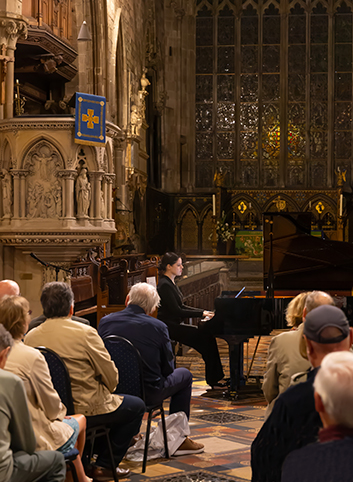
The Chopin Études are some of the most challenging and evocative pieces in the classical piano repertoire. A recital of all 27 of Chopin’s Études is an Olympian challenge and Shrewsbury was fortunate indeed to have them performed by the world-famous Russian pianist, Zlata Chochieva, on 30th September 2026.
In the interview before the recital, we learnt from Zlata how she had first performed the complete set as a final recital when graduating from the Moscow Conservatoire. Her subsequent recording of Chopin's Études was put together in a brief recording period but became iconic and was voted by Gramophone in the top ten Chopin recordings ever made. The recording was praised as "consistently inspired, masterfully executed and beautiful-sounding".
Her live recital in St Mary's Church on the evening of September 20th 2026 was quite breath-taking. Her superbly balanced hands and astonishing concentration brought a whole new sound-world to the Études. Her pianissimo was spell-binding and her ability to bring out melodies in these complex and beautiful works was revelatory. It was like hearing the works for the first time, yet with the conviction that Chopin would have been totally satisfied with her interpretation. There was delicacy, strength and poetry from her seemingly effortless and quite incredible technique.
The speed with which Zlata played some of the most complex piano music ever composed was phenomenal, clearly refined by hundreds of hours of practice. The pianos that Chopin played and composed on, had a very light touch compared to our modern instruments. No problem for Zlata who seemed to float effortlessly through the most complex studies. In the brief pause between each study, the audience was mesmerised and you could have heard a pin drop.
For a pianist who generally plays the best pianos the world has to offer, she had to make do with our modest Kawai, but the sounds she produced in the superb acoustics of St Mary's were quite magical. In the 15th century roof carvings directly above her, is the second oldest representation in the world of an early keyboard instrument being played, quite understandably, by an angel. Two days after the recital in St Mary's, our visiting Russian angel played the same programme to a sold-out audience at the Wigmore Hall in London.
Chopin’s Études are musical poems that blend virtuosity, lyricism, and inventive pianism. As a collection, every étude presents a distinct technical challenge while contributing to an emotionally rich overall experience. Chopin believed technique and expression were inseparable, prioritising expressive beauty above all. He pioneered the use of rubato and flexible phrasing within technical exercises, driven by the inspiration to make the piano sound as if it were singing. This was indeed the overall impression of Zlata's performance. You felt that if Chopin was tuning in to this superb recital, he would have been well pleased.
The beauty of the music and the haunting and heartfelt melodies that sang out, belied the technical difficulties incorporated. What a sublime experience, and how lucky we were to savour it in the hallowed space of St Mary's historic church. A standing ovation from an ecstatic audience was the least we could offer. Thank you, Zlata, for a completely unforgettable evening of heavenly music.
Audience comments
"She is one of very few pianists I would go out of my way to hear live nowadays regardless of the programme they play. I especially enjoyed her performance of the 2nd set of Etudes on Wednesday, which had a sense of unity to them I haven't heard before." Patrick
"Zlata’s recital was amazing! Today I woke up thinking what a sustained demonstration of skill, mental and physical concentration and stamina it was. In the flesh it was lovely to see her and experience her playing the huge range of music contained in these works. It has broadened my appreciation of Chopin's music." Geoffrey
"Last night's recital was excellent, thanks to Zlata's superb rendition of the Chopin Etudes. Her technique is first class and it seemed to me that her left hand works as well as her right." John