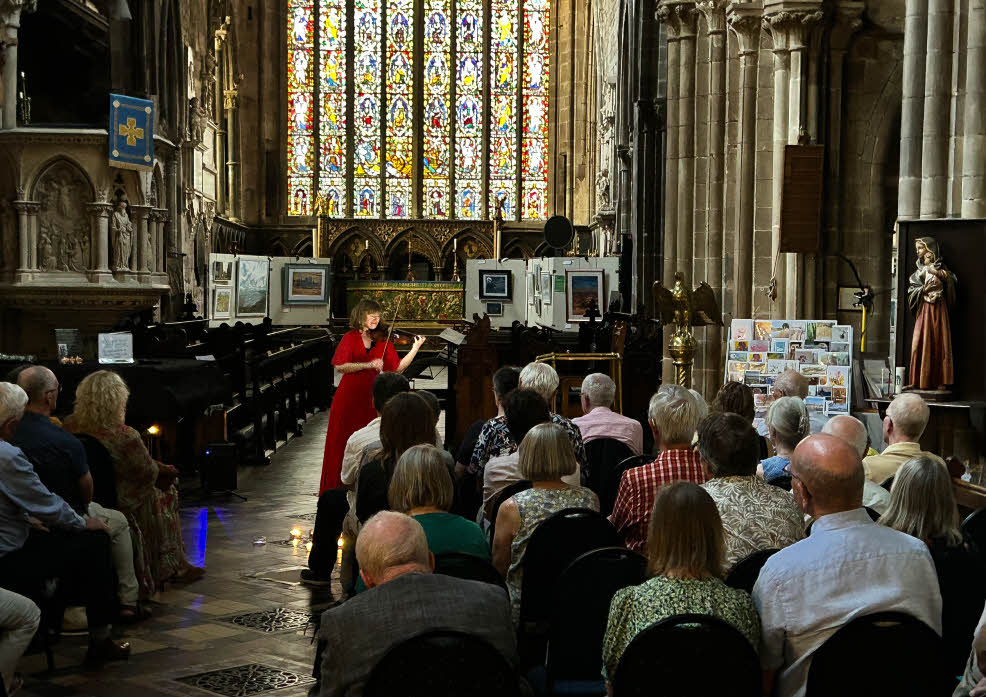
St Mary's Church in Shrewsbury was candlelit for Fenella Humphreys when she played the complete Sonatas and Partitas for solo violin by J.S.Bach for the first time in Shrewsbury's history. These works were written in a 5-year period when Bach was not required to write strictly religious music and during this time, under the employment of the Calvinist Prince Leopold, he composed the Orchestral Suites, the Brandenburg Concertos, the 6 Cello Suites and the 6 Sonatas and Partitas for solo violin.
Fenella played the works over two evenings on Friday 17th and Saturday 18th July at 7.30pm and discussed the programme with Peter Barritt at 7pm on each evening. On a beautiful sunny summer's evening sunlight illuminated stained glass in the beautiful Jesse window in the church.
The second recital was attended by the music critic, James Fraser Andrews, who writes...
There was a moment on Saturday, the last light draining from the clerestory and feeding, as it were, the candles’ dazzling bloom at her feet, when Fenella Humphreys’ violin achieved the perfect symbiosis between place, people, and music. It was the Largo of the third sonata in C which she had introduced, quite wonderfully, as something “magical…more than sunlight”. It was magic, and in the hands of this world-class musician, Bach’s artistry shimmered in sympathy with the gathering darkness too.
Humphreys, next year’s artist in residence at the Wigmore Hall, plays with a tone that is never merely beautiful; it argues. Opening with the second sonata in A minor, the double-stops of its Fuga had an almost architectural insistence, a feat of engineering in itself, each voice given its own weight as if the most intricate of stonemasonry were put into sound. The slow movements either side of it were searching and intimate, entirely suited to the half-dark.
The whole evening, her second instalment in her traversal of the Sonatas and Partitas over two nights, was a captivating dialogue between player and place. Behind her, the church’s famous Jesse window made its own argument for continuity. Edward III’s heraldic golden-plantains-in-glass rocketing like twin tracer fire into the heavens, generation flowering out of generation (such was the craftsman’s brief in the commission from a social-climbing knight) much as Bach's fugues flower out of the slightest subjects, as in the A minor, into orchards and forests that can bear the wildest of fruits, as in the C major fugue. Throughout, this jewel of a building was the violinist’s arch collaborator.
Alas I didn’t get to hear her Chaconne in the previous night’s concert, the mirthless clown-show of London & North Western Railways put pay to that. But the most sensitive of Bach interpreters – and on this showing Humphreys is clearly one of the very best –gets out of the way and gives one licence to imagine. She let the music speak for itself, the greatest of all artistic prizes available to a performer. Her phrasing was dulcimer-gentle, her presto in the B minor Partita had plenty of virtuosic fizz, yet the wow she left us with was utterly without ego. This is what world-class really sounds like.
Bravo to Dr Peter Barritt and the Shrewsbury International Recital Series for getting her to Salop. They are currently fundraising to pay for the new Kawai GX5 grand piano which has now arrived in St Mary’s for more nights of epic music-making in one of the most storied venues in Shropshire.